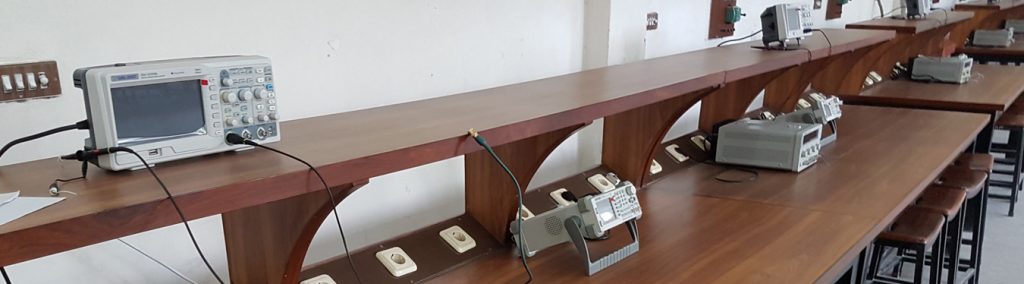
The B.Sc. Electrical Engineering Program is fully accredited at Level II by Pakistan Engineering Council.
UET Vision
To generate knowledge for global competitive advantage and become a leading world-class research University.
UET Mission
To play a leading role as a University of Engineering and Technology in teaching, research, innovation and commercialization that is internationally relevant and has a direct bearing on national, industrial, technological and socio-economic development.
Mission of the Department of Electrical Engineering, UET Lahore
To ensure understanding and application of electrical engineering fundamentals by inculcating analysis and design skills for the betterment of humanity and to become a center of excellence in the field of electrical engineering.
——————————————————————————————————————-
PEOs
PEO-1: Graduate should acquire and demonstrate their proficiency of electrical engineering knowledge by inculcating analysis and design skills using modern tools.
PEO-2: Graduate should possess the knowledge translation ability and contribute as an effective team member to reinforce their engineering competency.
PEO-3: Graduates should acquire strong moral values, ethical values, interpersonal and project management skills.
PEO-4: Graduates should build entrepreneurial and innovative mindset to address real world problems.
——————————————————————————————————————-
Program Learning Outcomes (PLOs)
The Department has adopted the same PLOs/GAs as given in PEC’s Accreditation Manual 2019. The Department ensures that its graduates have acquired the attributes defined in program learning outcomes/Graduate Attributes. The courses, in the curriculum, map to different PLOs/GAs. The PLOs/GAs are given below:
GA1/PLO-1 Engineering Knowledge: Apply knowledge of mathematics, natural science, engineering fundamentals and engineering specialization to the solution of complex engineering problems.
GA2/PLO-2 Problem Analysis: Identify, formulate, conduct research literature, and analyze complex Engineering problems reaching substantiated conclusions using first principles of mathematics, natural sciences and engineering sciences.
GA3/PLO-3 Design/Development of Solutions: An ability to design solutions for complex engineering problems and design systems, components or processes that meet specified needs with appropriate consideration for public health and safety, cultural, societal, and environmental considerations.
GA4/PLO-4 Investigation: Conduct investigation of complex Engineering problems using research-based knowledge and research methods, including design of experiments, analysis and interpretation of data, and synthesis of information to provide valid conclusions.
GA5/PLO-5 Tool Usage: Create, select and apply appropriate techniques, resources, and modern engineering and IT tools, including prediction and modeling, to complex Engineering problems, with an understanding of the limitations.
GA6/PLO-6 The Engineer and the World: Analyze and evaluate sustainable development impacts to society, the economy, sustainability, health and safety, legal frameworks, and the environment while solving complex engineering problems.
GA7/PLO-7 Ethics: Apply ethical principles and commit to professional ethics and norms of engineering practice and adhere to relevant national and international laws. Demonstrate an understanding of the need for diversity and inclusion.
GA8/PLO-8 Individual and Collaborative Team Work: Function e↵ectively as an individual, and as a member or leader in diverse and inclusive teams and in multi- disciplinary, face-to-face, remote and distributed settings.
GA9/PLO-9 Communication: Communicate effectively and inclusively on complex engineering activities with the engineering community and with society at large, such as being able to comprehend and write effective reports and design documentation, and make effective presentations, taking into account cultural, language, and learning differences.
GA10/PLO-10 Project Management and Finance: Demonstrate knowledge and understanding of engineering management principles and economic decision-making and apply these to one’s own work, as a member and leader in a team, to manage projects in multidisciplinary environments.
GA11/PLO-11 Lifelong Learning: Recognize the need for and have the preparation and ability for i) independent and life-long learning ii) adaptability to new and emerging technologies and iii) critical thinking in the broadest context of technological change.